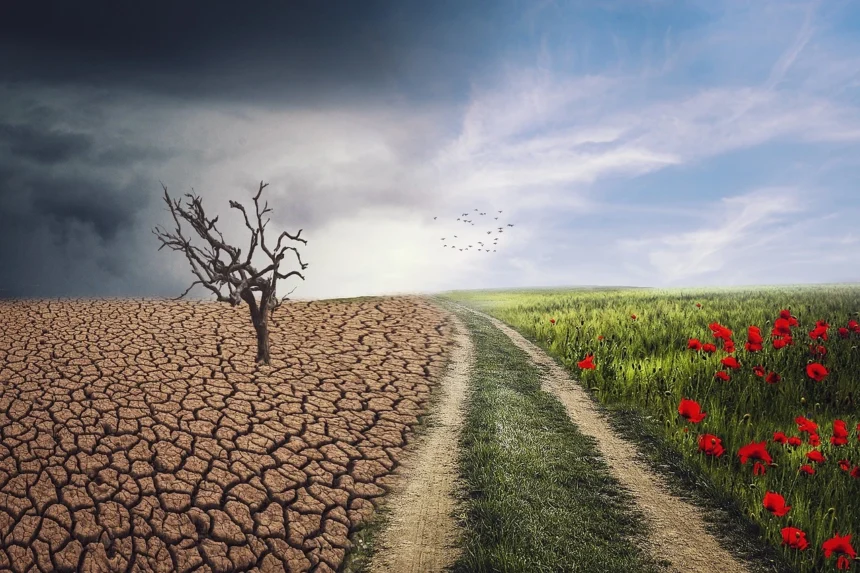
Climate change is mainly caused by human activities that release greenhouse gases. Burning coal, oil, and gas for energy traps heat in the air. Cutting down forests reduces nature’s ability to absorb carbon. Farming, factories, and waste also add gases that warm the planet and disrupt weather patterns over time around the world.
Causes of Climate Change
Climate change refers to long-term changes in Earth’s temperature and weather patterns. The main cause of today’s climate change is global warming, which is the gradual increase in Earth’s average temperature due to human activities.
Between 2015 and 2024, the world experienced the warmest decade ever recorded, and by 2024, global temperatures had reached about 1.55°C above pre-industrial levels. Human-caused warming is currently increasing at a rate of 0.25°C per decade, which is extremely fast in geological terms.
If global temperatures rise by 2°C or more, the impacts could be severe and irreversible. These include extreme heatwaves, rising sea levels, loss of ecosystems, food shortages, and serious risks to human health and wellbeing. Because of this, the global community aims to keep warming well below 2°C and ideally limit it to 1.5°C.
Reference: European Commission – Causes of Climate Change
Global Warming and the Greenhouse Effect
Global warming is driven mainly by the greenhouse effect. Certain gases in the Earth’s atmosphere trap heat from the sun, much like the glass walls of a greenhouse. Climate change makes mold toxicity worse by creating warmer, wetter conditions where harmful mold can grow more easily.While this effect is natural and necessary for life, human activities have greatly increased the amount of heat-trapping gases, making the planet warmer than normal.
Major Greenhouse Gases Increased by Humans
- Carbon dioxide (CO₂) – released mainly from burning coal, oil, and gas
- Methane (CH₄) – released from agriculture, livestock, landfills, and fossil fuel extraction
- Nitrous oxide (N₂O) – released from fertilizers and industrial processes
- Fluorinated gases – man-made gases used in cooling and industrial products
CO₂ is the largest contributor to global warming. By 2023, its concentration in the atmosphere was about 51% higher than before 1750. Some gases, like methane, are more powerful than CO₂ but stay in the atmosphere for a shorter time. Others, like nitrous oxide, remain for centuries.
Reference: Met Office – Causes of Climate Change
Human Causes of Climate Change
Since the Industrial Revolution (1800s), human activities have become the dominant cause of climate change.
Human Activities
- Burning fossil fuels for electricity, heating, and industry
- Transportation using cars, trucks, ships, and airplanes
- Deforestation, which reduces the number of trees that absorb CO₂
- Agriculture, especially livestock farming and fertilizer use
- Industrial processes that release greenhouse and fluorinated gases
Scientists can confirm that this warming is human-caused because greenhouse gases carry a distinct chemical fingerprint linked to fossil fuels. According to the Intergovernmental Panel on Climate Change (IPCC), it is unequivocal that human activities are the primary driver of recent climate change.
Reference: United Nations – Causes & Effects of Climate Change
Climate Change Weather Effects
Climate change is already affecting the weather worldwide. According to the IPCC’s Sixth Assessment Report (2021), human activities have warmed Earth by nearly 1.1°C (2°F) since the late 1800s. Global temperatures are expected to rise by 1.5°C in the coming decades, affecting every region through rising seas, stronger storms, longer wildfire seasons, and more extreme weather.
Climate Findings
- Earth will continue to warm, and the effects will be serious
- Global temperatures may exceed 1.5°C soon
- Sea levels could rise 1 to 6.6 feet by 2100
- Wildfires are becoming more frequent and intense
- All regions of Earth will be affected
Effects of Climate Change on the Planet
- Average global temperatures have risen by over 1°C since the 1850s
- The oceans absorb 90% of the extra heat, causing them to expand
- Melting glaciers and ice sheets add more water to the seas
- Global sea levels rose about 20 cm between 1901 and 2018
- Polar regions are warming faster, speeding up ice loss
- Arctic ice is 65% thinner than in 1975
- Ocean acidification harms coral, fish, and marine food chains
Major Planetary Changes Caused by Climate Change
| Area Affected | What Is Happening | Result |
| Global Temperature | Rising steadily | Hotter years worldwide |
| Oceans | Absorbing heat & CO₂ | Sea level rise & acidification |
| Polar Ice | Rapid melting | Faster warming |
| Glaciers | Shrinking | Freshwater added to oceans |
| Ocean Currents | Slowing | Disrupted climate patterns |
Changes to the UK Climate and Weather Events
| Weather Event | Change So Far | Linked to Climate Change? | Expected Future Change |
| UK warm spells | Increase | Yes | Increase |
| UK cold spells | Decrease | Yes | Decrease |
| UK heavy rain | Increase | Inconclusive | Increase |
| UK dry spells | No clear trend | Inconclusive | Increase (summer) |
| UK wind storms | No clear trend | Inconclusive | Increase* |
Effects of Climate Change on Humans
- 39% of people live close to coastlines
- Around 600 million people live in low-lying coastal areas
- Rising seas increase flooding and force people to relocate
- Even with reduced emissions, sea levels will rise until 2100
- Stronger flood defenses can reduce damage and displacement
How Climate Change Is Affecting the UK
- All 10 warmest UK years happened after 2002
- Heatwaves are now 30 times more likely
- Winters: warmer and wetter
- Summers: hotter and often drier
- By 2050, severe heatwaves may occur every other year
UK Climate Projections by 2070
- Winter: 1–4.5°C warmer, up to 30% wetter
- Summer: 1–6°C warmer, up to 60% drier
- Heavy rainfall events are more frequent
Future Effects of Climate Change
- 250,000 extra deaths per year expected by 2030–2050
- Over 140 million people may be displaced by 2050
- Food shortages, heat stress, and disease risks will rise
- Climate adaptation is now necessary, not optional
Top 10 U.S. Disasters by Cost (2000–2022)
| Event | Year | Cost (USD) | Fatalities |
| Hurricane Katrina | 2005 | $193.8B | 1,833 |
| Hurricane Harvey | 2017 | $155.0B | 89 |
| Hurricane Ian | 2022 | $115.2B | 152 |
| Hurricane Maria | 2017 | $111.6B | 2,981 |
| Hurricane Sandy | 2012 | $85.9B | 159 |
| Hurricane Ida | 2021 | $82.4B | 96 |
| Hurricane Irma | 2017 | $62.0B | 97 |
| Hurricane Andrew | 1992 | $58.6B | 61 |
| U.S. Drought/Heatwave | 1988 | $52.8B | 454 |
| Midwest Flooding | 1993 | $44.9B | 48 |
Major U.S. Drought Events (2000–2011)
| Year | Cost (USD) | Key Impact |
| 2000 | $9.0B | Heat deaths & crop losses |
| 2002 | $15.5B | Drought across 30 states |
| 2003 | $8.4B | Heatwave caused 35 deaths |
| 2005 | $2.4B | Crop losses |
| 2008 | $10.2B | Severe heat & low lake levels |
| 2009 | $5.1B | Agricultural damage |
| 2011 | $16.6B | Heatwave caused 95 deaths |
Recent U.S. Drought Events (2012–2022)
| Year | Cost (USD) | Key Impact |
| 2012 | $40.5B | Worst drought since 1930s |
| 2013 | $13.8B | Heat deaths & crop loss |
| 2015 | $5.9B | California drought |
| 2016 | $4.4B | Over 100 million trees lost |
| 2020 | $5.3B | Heat + wildfire risk |
| 2021 | $9.9B | Historic heatwave |
| 2022 | $22.9B | Reservoir depletion |